How my team of virtual assistants inspired me to be an entrepreneur

To be honest, I never thought I'd end up building an outsourcing company. So cliché. I always pictured myself inventing the next Spotify or Uber, something more revolutionary.
- Outsourcing to India solved cost, not language or time zone. Colombia solved all three.
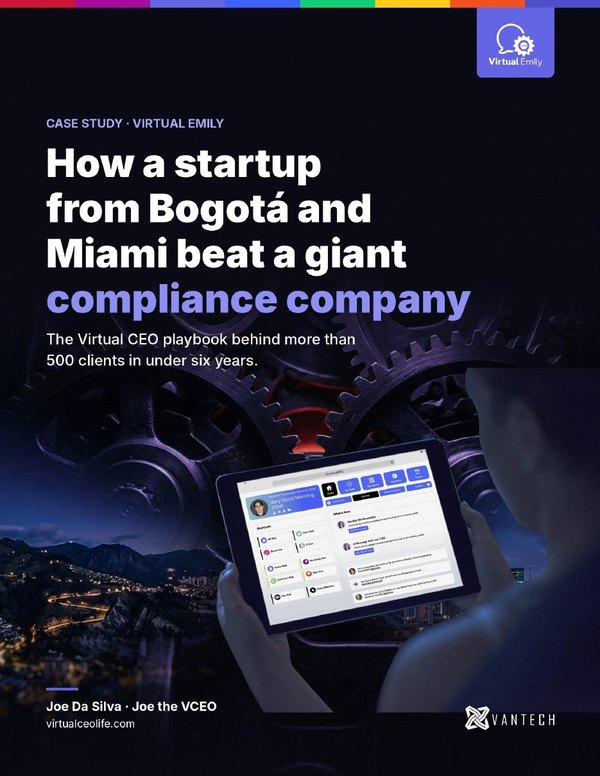
- A remote team helped take my former boss's startup from zero to 500+ clients in under six years.
- The recipe wasn't the cost. It was connecting with people and building a bridge between two cultures.
The judgment I had to unlearn
When I thought about outsourcing, I pictured call centers and coders working for cents on the dollar in bad conditions. I couldn't have been more wrong about what it could be.
When my former boss started his company, I saw up close how much outsourcing mattered. It gave a cash-strapped startup an affordable way to grow. They had an outsourced team in India and were hiring left and right.
But there was a problem. That team couldn't cover English and Spanish together, and the time-zone gap hurt the work that needed a live conversation: sales support, scheduling, assistants.
The bet on Colombia
That's when the idea hit me: why not Colombia? Bilingual talent, a culture close to ours, and a time zone that lines up with the US East Coast and Central time. I bet we could compete on cost and deliver talent better suited to American businesses.
I had no idea it was the beginning of something much bigger.
Fast-forward a few years. That operation went from zero market share to leading its market, with more than 500 clients in under six years and year-over-year sales growth of at least 60%. Thanks to the remote team, the company could also hire strong senior leadership in Miami. We were creating jobs in Colombia and in Miami at the same time.
The people who made it work
My recipe was never the price. It was connecting with people in a personal, profound way: learning their culture, caring about their needs and understanding what a good business relationship meant to them.
Juan was my first virtual assistant, hired from Miami into our team in Bogotá. We connected instantly. A few months later he told me the stability of that job let him marry the love of his life and take her to meet Mickey Mouse. It's one of the proudest moments of my life. We're still friends.
Sabrina started as my personal assistant and became so effective she went on to run headhunting and sales.
Oscar, my head researcher, builds the databases behind our lead generation and keeps the whole team's projects moving. He once turned down a job at a well-known consulting firm because he believed in me and the startup. That gave me the push I needed to keep going. It still does.
Why I love being the bridge
Is it hard to work with a remote team? It's easy, and it's amazing, when you hire the right people and give them a system to work in.
Today my Emilys work as community managers, designers, sales reps and bookkeepers. That frees me to focus on one thing: connecting brave entrepreneurs with talent that changes their business, while creating dignified jobs along the way.
I see myself as the bridge. Language, communication and business expectations differ a lot between regions, and those gaps are where most outsourcing goes wrong. That's why we work from Miami, Bogotá and Barranquilla: to build a bridge between both cultures.
And that's why every Emily is trained in Emily Academy and managed on MyVirtualBPO before she ever joins your team. When everyone wins, you get to play the long game: partnerships built on trust, quality and growth for everyone involved.
What a remote team teaches a founder
My first assistants taught me things no MBA did. Three of them shaped how Virtual Emily works today.
- People rise to the standard you set. When we wrote down what "done" looked like, quality stopped depending on my mood. That became our Statement of Work.
- Talent is everywhere; opportunity isn't. The best people on my early team had never been given a real career path. Training them changed their lives and my business at the same time.
- Visibility builds trust in both directions. When the team could see the goals and I could see the work, we stopped needing check-in calls.
If you're thinking about your first remote hire
Start with the work, not the person. Pick one function, define two or three numbers that show it's working, and look for a partner that trains and supports the people you hire. The rest is rhythm: a daily report, a weekly review, and the patience to give feedback early.
Questions owners ask
Why hire in Colombia instead of offshore?
Colombia runs on UTC-5 year-round, so the workday overlaps fully with US Eastern and Central time. Add bilingual talent and cultural closeness, and live conversations stop being a scheduling problem.
Is an Emily a freelancer?
No. An Emily is trained, managed and US-contracted, and works on MyVirtualBPO with live KPIs. A VA is a freelancer you manage on your own. An Emily, not a VA.
How much does a remote hire cost?
Roles on the Virtual Emily ladder start at $1,500/mo for full time. See the Virtual Emily plans for the full ladder.