Meet Emily: the new generation of remote executive

Every entrepreneur, executive and CEO wants an Emily. The question is what makes one great, and why a great one is not the same thing as a virtual assistant.
- An Emily is trained, managed and US-contracted, and owns a function. A VA is a freelancer you manage alone.
- Our first Emily named five traits: obliging, organized, empathetic, proactive, always learning.
- Every Emily is trained in Emily Academy and works on MyVirtualBPO, so you see her KPIs live.
Why we call her Emily
TV is full of "perfect" assistants. Think of Suits, Drop Dead Diva or Criminal Minds. But the one everybody remembers is Emily.
In The Devil Wears Prada, Emily Charlton isn't even the main character. She's famous because her boss, Miranda Priestly, called every assistant "Emily." To Miranda, they were all the same. Andrea, the new assistant, also called Emily, worked so hard to be different that she became the best one in the building. Not without a problem or two.
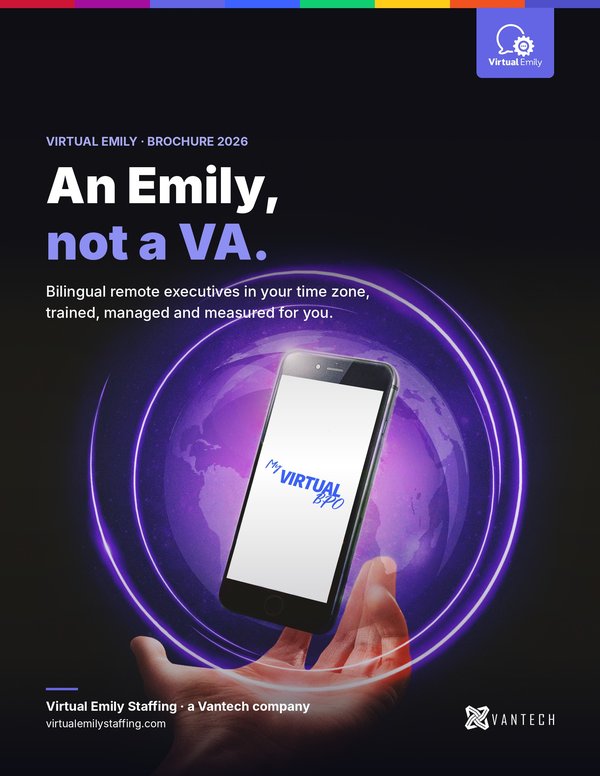
We flipped the joke. At Virtual Emily, every Emily is trained, managed and impossible to replace with a template. We say it in five words: An Emily, not a VA.
An Emily, not a VA
A VA does tasks. An Emily owns a function. She anticipates what you need before you ask. Here's the difference in practice:
- Trained before day one in Emily Academy on the same operating manual we run on (EMOP), written to ISO 9001 standards.
- Bilingual and in your time zone, working your hours.
- US contract, with a dedicated account manager behind her.
- Measured, not micromanaged: her tasks, hours and KPIs are live on MyVirtualBPO.
- Free unlimited replacement guarantee for the entire duration of your agreement. If a match isn't right, we find and train a replacement at no charge.
What makes an assistant great, in our first Emily's words
Our first Emily wrote down what she believed makes a great assistant. It still holds.
1. Be obliging
Not everyone has this gift. If you want to assist, you have to like it, and it has to come from inside. She loved customer service, being the person who solves things, and following instructions well.
2. Be organized. Really, really organized
Documents, folders, email, even the desk. Organization is the core of assisting.
3. Empathy and rapport
Walk in someone else's shoes. You're not only an employee, you're part of a team, and your boss's success is your own. "Happy boss, happy work," she used to say.
4. Be proactive
Optimize time, look for solutions and make processes more efficient every day. The CEO and the Emily become an extension of each other.
5. Keep learning
Find new ways to optimize, update yourself and get better at what you do. After her first year, her boss called her his partner. She understood his needs and how he wanted things to work, and she was also his friend.
Can AI replace an Emily?
AI is catching up with "assistant" work, and we use it. On MyVirtualBPO, AI takes the repetitive work off your Emily's plate. But a tool doesn't understand your business, your clients and your priorities the way a person does. It can't help you become a better owner.
Our view: AI handles the volume, the Emily owns the outcome. Each makes the other better.
What an Emily actually does in her first 30 days
Owners often ask what to expect after they pick an Emily. A typical first month looks like this:
- Week 1, onboarding. Access to your tools, the Statement of Work, and a walk-through of how you like things done. Screen recordings save hours here.
- Week 2, the rhythm starts. Daily reports begin, and the first recurring tasks move fully to her.
- Week 3, the first function. She owns a full block, such as inbox and calendar or invoicing and follow-ups, measured on two or three KPIs.
- Week 4, review. You and your account manager look at the numbers and decide what to hand over next.
Why the name matters
Calling every assistant Emily used to mean they were interchangeable. We use it for the opposite reason: every Emily is trained to the same standard, so you can trust the experience before you know the person.
Questions owners ask
What is the difference between a virtual assistant and an Emily?
A virtual assistant is usually a freelancer you recruit, train and manage yourself. An Emily is vetted, trained in Emily Academy, US-contracted, managed with an account manager and tracked on MyVirtualBPO, with a free unlimited replacement guarantee.
How fast can I interview an Emily?
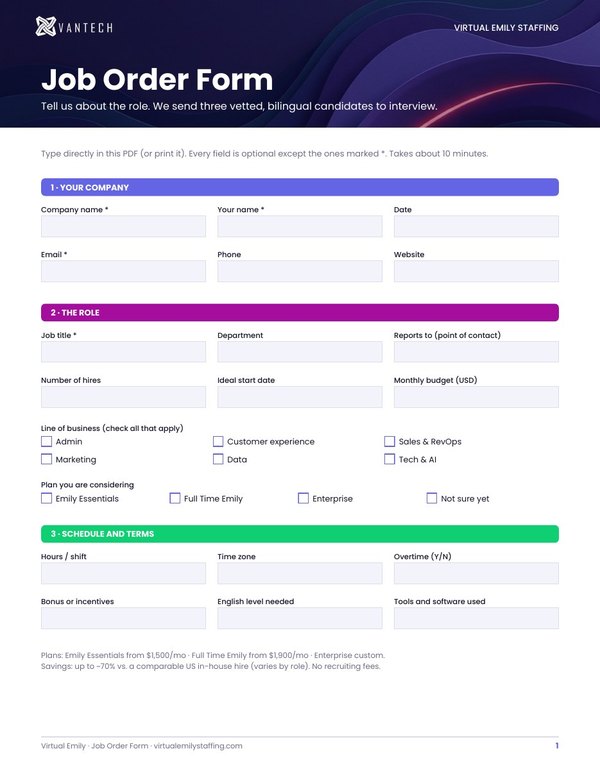
In as little as 72 hours. You interview three vetted candidates free before you commit.
How much does an Emily cost?
Full-time Emilys start at $1,500/mo, depending on the role and level. MyVirtualBPO is included at no extra cost.