7 signs it's time to hire a virtual assistant (and why you need an Emily)

You don't need another productivity hack. You need to stop being the bottleneck in your own company. Here are the seven signs I see in almost every owner before their first Emily, and what each one costs you.
- Three or more of these signs means your time is the constraint on growth.
- Start with the area that drains you most, not the one that's easiest to hand off.
- An Emily arrives trained and measured, so delegating doesn't become a second job.
1. Everything waits on you
Approvals, answers, decisions. If the team can't move without your sign-off, your calendar is the speed limit of the company.
2. You're doing $15-an-hour work with $1,000-an-hour time
Inbox triage, scheduling, data entry, chasing invoices. Price your own hour honestly, then look at how much of your week goes to work you'd never hire yourself to do.
3. Follow-up falls through the cracks
Leads go cold. Proposals sit unsent. Clients wait for answers. Every dropped follow-up is revenue you already paid to generate.
4. You haven't taken a real day off in months
If the business can't survive a day without you, you don't own a business. You own a job with a lot of overhead.
5. Growth feels like drowning
New clients should feel like winning. If each one adds stress instead of margin, your operation isn't built to scale yet.
6. You only work in the business, never on it
Strategy, partnerships, the next product, hiring well. If those keep getting pushed to "next week," the urgent is eating the important.
7. You can't see your numbers without a fire drill
If knowing your cash, pipeline or margins means a spreadsheet hunt, you're flying blind. Clarity is the third engine of the Virtual CEO Life.
Nodded at three or more? Here's what to do
- Pick the area that hurts most: admin, customer experience, sales, marketing, data or finance.
- Write down what "done" looks like for that area, with one or two KPIs.
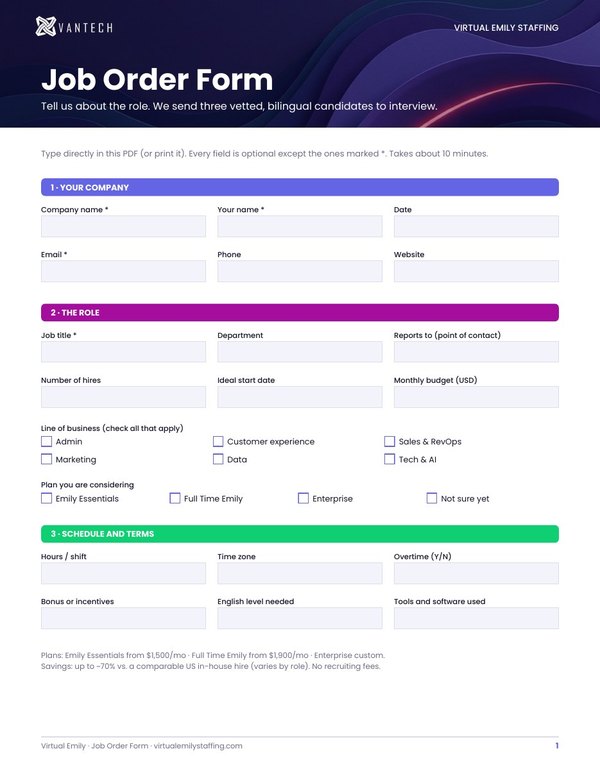
- Hire an Emily, not a VA. A VA is a freelancer you recruit, train and manage alone. An Emily is vetted, trained in Emily Academy, US-contracted and tracked on MyVirtualBPO, with a free unlimited replacement guarantee for the entire duration of your agreement.
You can interview three vetted candidates in as little as 72 hours. Full-time Emilys start at $1,500/mo.
What to do once you've counted your signs
If three or more of the signs fit, the next step is not a job post. It's a short inventory:
- List the work that triggered the signs. The missed follow-ups, the late invoices, the inbox at midnight.
- Group it into one function. Admin, customer experience, sales support, marketing, data or finance back office.
- Pick two numbers that would prove it's fixed. Response time, invoices sent on time, meetings booked.
- Interview three candidates. With Virtual Emily you can do that in as little as 72 hours, free.
What it costs to wait
Every month you delay, you keep paying the most expensive person in the company, you, to do work that doesn't need you. That cost never shows up on the P&L, which is exactly why it's easy to ignore.
Questions owners ask
Should I hire a virtual assistant or a full-time employee?
If the work is repeatable and can be measured, a remote Emily typically costs up to ~70% less than a comparable US in-house hire (varies by role), with no recruiting or HR overhead on your side.
What should my first remote hire do?
Whatever drains your best hours. For most owners that's admin and inbox, customer follow-up or sales support. See 5 tasks to outsource first.