5 benefits of hiring remote employees for a small business

Remote hiring used to be the cheap option. Today, done right, it's the smart one. Here are five benefits small-business owners see when they hire remote employees, and the one risk you have to manage.
- Cost: up to ~70% less than a comparable US in-house hire (varies by role).
- Talent, time zone and speed: a bigger pool, working your hours, interviewed in days.
- The risk is managing people you can't see; the fix is a platform and a partner.
1. Lower cost, without lower quality
A bilingual remote professional in Colombia typically costs up to ~70% less than a comparable US in-house hire, depending on the role. No office, equipment or local benefits on your side. On the Virtual Emily ladder, full-time roles start at $1,500/mo.
2. A much bigger talent pool
Hiring locally limits you to people within commuting distance. Remote hiring lets you search by skill, role and English level. That's how small companies get specialists, a bookkeeper, a CRM admin, a data analyst, they could never find nearby.
3. Your time zone, your hours
Offshore teams on the other side of the world turn every question into a next-day answer. Nearshore talent in Colombia works on UTC-5 year-round, overlapping fully with US Eastern and Central time. Live calls, same-day answers.
4. Faster hiring
A local hire can take weeks of posting, screening and interviewing. With a staffing partner, the screening is done before you see a profile. You can interview three vetted candidates in as little as 72 hours.
5. Visibility you didn't have before
This is the one owners don't expect. When remote work is run properly, every task, hour and KPI is logged on a platform like MyVirtualBPO. You often see more of a remote employee's work than you did of the person sitting down the hall.
The risk to manage
The real risk of remote hiring isn't distance. It's managing people without a system, and ending up as everyone's full-time supervisor. Avoid it with three things:
- A partner who trains and supports the person, not just a job board.
- One platform where the work is visible.
- A daily report rhythm. Read the pros and cons of a remote team for the full picture.
How to get the benefits without the risk
The five benefits only show up when remote work is structured. A short checklist:
- Start with one function and two or three KPIs.
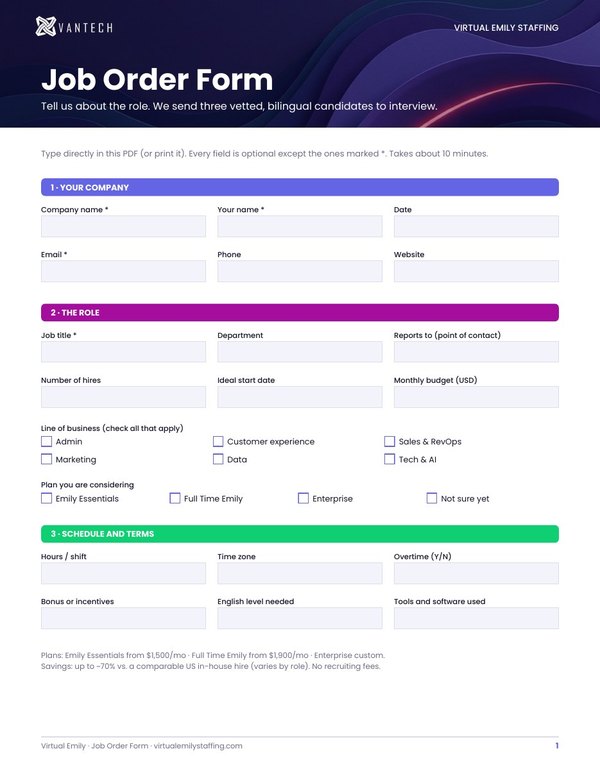
- Write a Statement of Work before day one: scope, schedule, tools, reports.
- Use one channel for direction and one place for the work.
- Ask for a daily report and review it every day for the first month.
- Choose a partner with a replacement guarantee, so a bad match doesn't cost you months.
When remote hiring isn't the answer
If the role needs someone on site, or you can't spare any time for onboarding, wait. Remote hires succeed when the owner invests a little time early to save a lot of time later.
Questions owners ask
Are remote employees as productive as in-office staff?
They can be more productive when work is defined by outcomes and measured on a dashboard. Without structure, any team, remote or not, drifts.
What roles work best remotely?
Admin, customer experience, sales support, marketing, data, finance and tech roles all work well. On our ladder that's six lines and 44 roles.