3 things to get right before hiring your first remote assistant

Most first remote hires don't fail because of the person. They fail because the founder skipped the prep. Get these three things right and your first hire feels like relief, not risk.
- Record one process before you hire. That's your first SOP.
- Define what good looks like with one or two KPIs.
- Pick a partner who trains and measures, or you'll be managing a second job.
1. Document one process
If it only lives in your head, nobody else can run it. You don't need a manual. You need one process, written down once.
The fastest way: record your screen while you do the task, talking through it. That recording is your first SOP (standard operating procedure). Your Emily turns it into a written checklist in week one.
Start with something that repeats every week: inbox triage, appointment scheduling, invoice follow-up or the weekly report.
2. Decide what "good" looks like
Vague hope is the most common hiring mistake. Before day one, write:
- The outcome: "every lead gets a reply within two business hours."
- One or two KPIs: response time, tasks completed, invoices collected.
- The rhythm: a good-morning message with the plan and a good-night report with results.
That last one is one of the six habits of a Virtual CEO, and it's baked into every Emily's Statement of Work.
3. Pick a partner, not a freelancer
A freelancer you find, train and manage alone is a second job. That's fine for a one-off project. For a role that runs part of your company, you want:
- Someone trained before day one, so you're not the trainer.
- A US contract and a dedicated account manager.
- Visibility: tasks and KPIs on a dashboard, not a weekly "how's it going?"
- A replacement guarantee if it isn't a fit.
That's the difference between a VA and an Emily. Every Emily is trained in Emily Academy and works on MyVirtualBPO, included with every placement.
What the first 30 days look like
- Week 1: your Emily learns the process you recorded and writes it up.
- Week 2: she runs it while you review the daily report.
- Weeks 3–4: you stop reviewing every task and start checking the dashboard.
By day 30 you should have your first hours back. If not, the process or the KPI needs work, and that's what the account manager is for.
A one-page brief you can write today
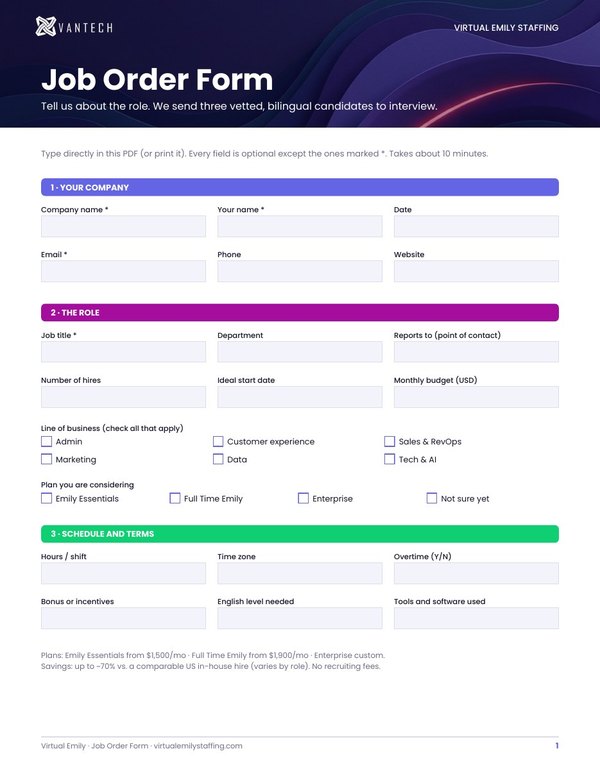
Before you talk to any provider, put these on one page:
- The function: one sentence on what the person will own.
- The tasks: the ten things they'll do most often.
- The tools: every app they'll need access to.
- The numbers: two or three KPIs that tell you it's working.
- The rhythm: daily report, weekly review, how urgent questions reach you.
- The hours: the schedule you need covered, in your time zone.
The first two weeks
Plan onboarding like you would for an in-office hire: access on day one, recorded walkthroughs of how you work, and a first small win by the end of week one. The first two weeks decide whether a remote hire becomes an Emily or another tool you never use.
Questions owners ask
Do I need SOPs before hiring an assistant?
One is enough to start. Record it once; a trained Emily can turn it into a written SOP and build the rest with you.